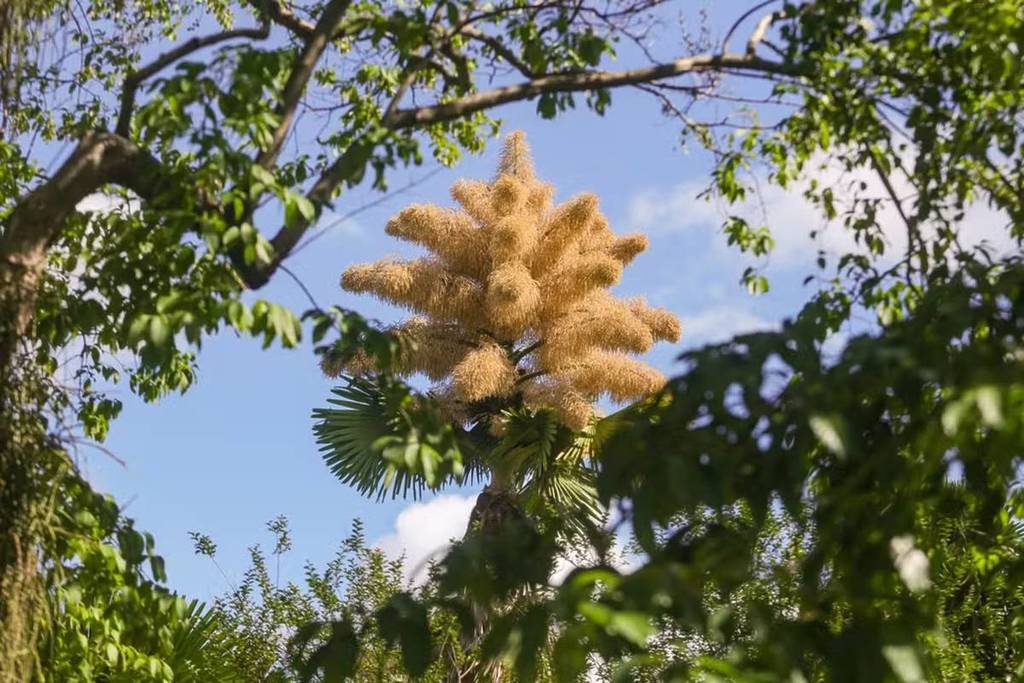
A very rare phenomenon is attracting the attention of locals and tourists who pass by Aterro do Flamengo and the Botanical Garden. These are the talipot palm trees, a species that only blooms once in its lifetime, usually between 50 and 70 years after planting! Find out more about this rarity in Rio de Janeiro!
Talipot palms are native to South Asia and grow up to 30 meters tall

If you’ve never heard of talipot palms before , we’ve got you covered. With the scientific name Corypha umbraculifera, talipot palms are not Brazilian plants.
They are native to southern India and Sri Lanka and can reach heights of up to 30 meters! In addition, the imposing species produces around 25 million flowers, using the energy accumulated over decades.
But why are talipot palms attracting so much attention among locals and tourists? It’s because it’ s a rare species that only blooms once in its lifetime. Generally, flowering, which colors the top of the canopy yellow, only happens at the end of its cycle, between 50 and 70 years old!
After that, the senescence phase begins, in which it loses its leaves and dies, and this process lasts about a year.
The rare species was planted by Roberto Burle Marx in the 60s

Well, if flowering only starts after half a century, then who was responsible for planting the talipot palm trees in Rio de Janeiro?
It was landscape designer Roberto Burle Marx, who brought the palms from Asia to Brazil in the 1960s, when he was designing the park at Aterro do Flamengo.
In addition to the Aterro, the Sítio Burle Marx and the Rio de Janeiro Botanical Garden have also received the famous species. It is estimated that those in the Botanical Garden are the same age as those in the Aterro, since they are blooming at the same time.
Those at Sítio Burle Marx, on the other hand, are still waiting for their turn to bloom.
How long will it be possible to see talipot palms in Rio?
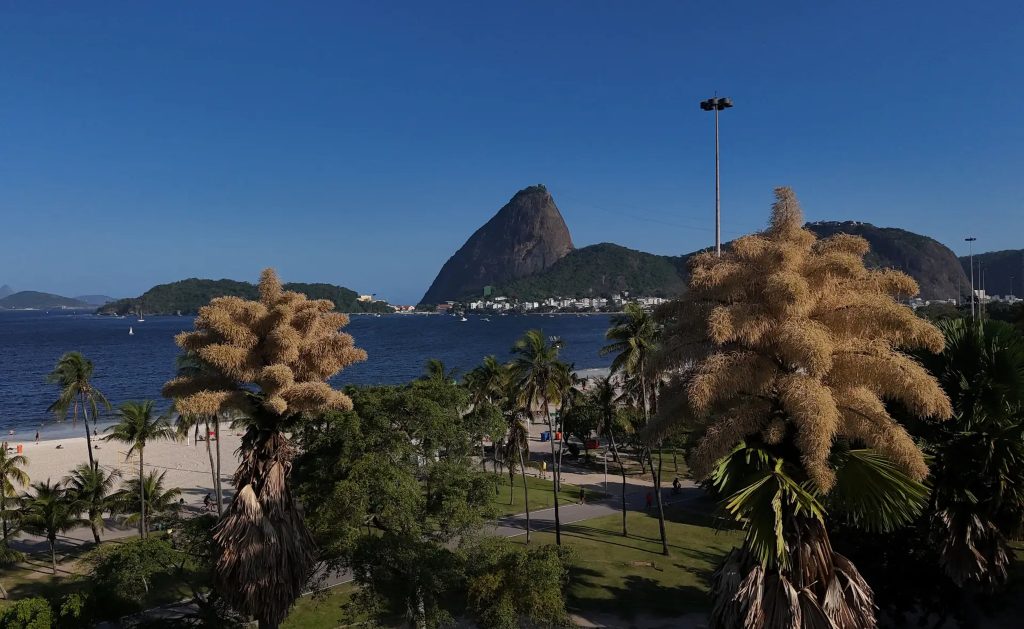
If you’re curious to see the talipot palms up close, there ‘s still time! As mentioned above, the species takes about a year to complete its cycle.
What’s more, the researchers at the Rio Botanical Garden intend to produce seedlings from the fruit, to be planted in squares and public spaces at a later date.
This way, future generations will also have the chance to see this rare phenomenon of nature on Rio’s soil!